

01 Focus on the full process, deliver integrated casting solutions

With over two decades of deep focus on non-ferrous casting equipment, Wanfeng Tech. has not limited to single forming machines. LPDC, CPC, and GDC casting equipment are our traditional strengths. For large thin-wall components such as NEV battery packs and chassis sub-frames, we can provide turnkey automated production lines covering melting, forming, robotic extraction, and post-processing. The new generation of CPC machines and tilting GDC machines has achieved technical breakthroughs, with performance benchmarked against imported equipment, solving the difficulty of expensive spare parts and long maintenance cycles for overseas machines.
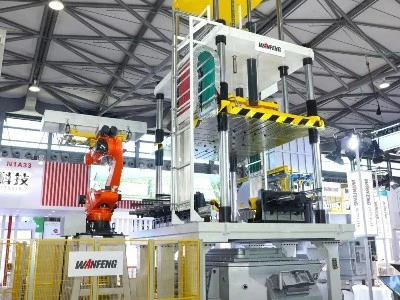
LPDC Machine
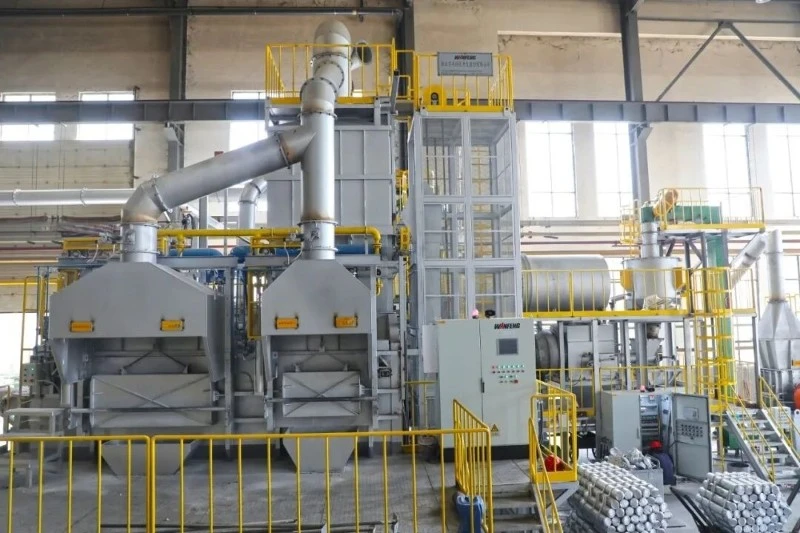
Melting production line
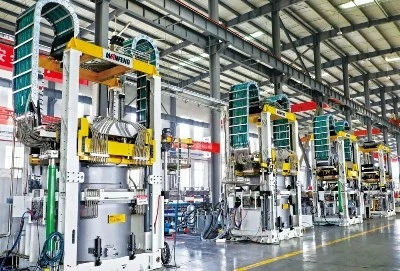
CPC machine
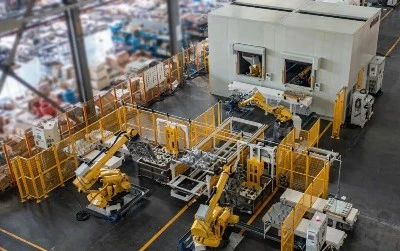
Post-processing production line
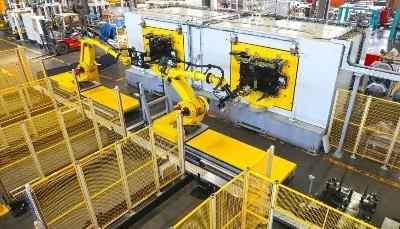
Post-processing line for mega-casting
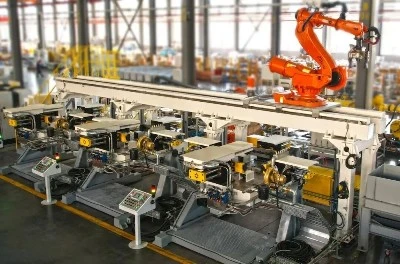
GDC Production line
Beyond the forming stage, Wanfeng Tech. also strengthens melting and holding, and aluminum chip recovery and purification, while covers the full post-processing sequence: trimming, decoring, grinding, and five-axis cutting. Therefore, even for HPDC plants, Wanfeng Tech. can supplement two major gaps of the die casting island without developing machines - upstream molten aluminum preparation and downstream casting cleaning - while providing a foundry MES system to connect full-chain data, helping factory achieve an automated closed loop from aluminum feeding to finished casting cleaning, eliminating the inconvenience of coordinating multiple suppliers.
02 Tackling post-processing to resolve mega-casting production issues
Wu Jun, CEO of Wanfeng tech., noted that after the widespread adoption of large integrated castings, post-processing has become a capacity challenge for many plants: grinding stations are dusty and harsh, and even with high pay it is hard to recruit workers; manual operation leads to inconsistent deburring, with over-grinding or residual material; conventional robots lack rigidity and are inefficient at cutting large-size gates and risers.

Addressing these issues, Wanfeng Tech. has independently developed a complete matrix of post-processing equipment: 50–400-ton series trimming presses, 350–1200 series six-axis CNC grinding machines, and five-axis CNC cutting machines specifically adapted for battery packs and sub-frames, capable of gate and riser cutting, flash and deburring, and rough machining. Compared with conventional robot solutions, five-axis CNC equipment offers greater rigidity, smaller gate/riser residuals, and improved control over aluminum chip scattering in the workshop. The entire post-processing equipment can also interface with the MES to collect data on equipment status, shift output, energy consumption, and OEE, supporting lean-staffing transformation on the shop floor.

Regarding this, Wu Jun said: "Many enterprises focus on die-casting forming, but post-processing is also a major factor in the final casting yield. Post-processing automation is not simply replacing labor; it is about stabilizing finished-product consistency and bringing yield control to whole process."
03 Building dual advantages in process and service on hard technical strength
The equipment market is fiercely price-competitive, but casting equipment is not a simple hardware transaction; process adaptation and full-life cycle service are what set suppliers apart. As a key drafter of industry standards and holder of over 200 granted patents, Wanfeng Tech.'s greatest advantage is being "an equipment supplier that understands casting process." Unlike suppliers that only sell machines, the team combines equipment R&D with casting process know-how: it participates deeply in customer product review and production-line planning upfront, handles installation, commissioning, and trial-production support during the project phase, and provides remote diagnosis, on-site maintenance, and spare-parts assurance after launch - delivering full-life cycle service. In addition, backed by Wanfeng Group resources, it also has localized service capabilities overseas.
Workshop project installation site
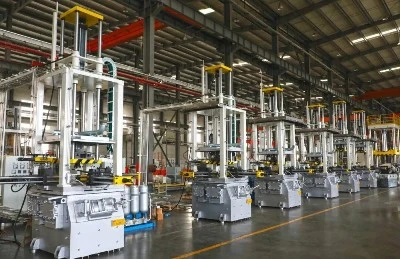
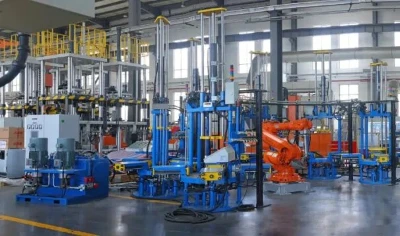
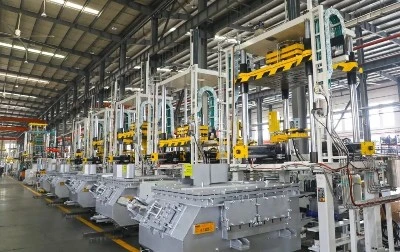

With over a thousand production lines deployed across more than two decades, the company has built a process database covering castings of different materials and structures, enabling early prediction of production defects and matching of equipment parameters to help customers improve line OEE, which is the practical experience that pure equipment vendors rarely accumulate.
04 Seizing overseas opportunities amid industry transformation
On the current state of the aluminum alloy casting industry, Wu Jun judged that the sector has entered a period of structural change. Large integrated castings remain the clear main trend, but the market is gradually separating genuine capability from hype; low-end capacity competing solely on price will be cleared out faster. Customer purchasing logic is shifting: they no longer focus only on the initial equipment purchase price, but on life-cycle value such as yield, uptime rate, and maintenance cost. Intelligence and digitalization are no longer optional - MES integration across the line and full-process control of quality, energy, and equipment status will become standard for leading plants. Meanwhile, under the dual-carbon agenda, melting energy-saving and green production have also become hard requirements.
While domestic competition intensifies, opportunities are emerging in overseas markets. Wanfeng Tech began global expansion early - our low-pressure casting equipment was exported as early as 2007. In recent years, we has further deepened international business through industrial and market synergy within the Wanfeng Group. For example, in 2016 Wanfeng acquired Paslin, a leading North American automation integrator in the U.S., achieving synergy in technology, customers, and service resources: Paslin handles North American automation projects, local delivery, and after-sales, while Wanfeng supplies casting machines and automated post-processing equipment, forming integrated solution capability linked across domestic and overseas markets.

"Overseas markets are relatively rational; customers value line stability, delivery capability, and localized after-sales - these are favorable conditions for our steady overseas growth," said Wu Jun. In market strategy, Wanfeng does not simply sell equipment abroad; we adapts to local conditions, customizing to target-market requirements and pairing with overseas technical teams for installation, commissioning, and after-sales maintenance. "Wanfeng Technology has established a localized overseas service network across three core markets - North America, India, and Southeast Asia - and is building China's self-developed high-end casting intelligent equipment into a brand trusted by global customers."
Amid the wave of large lightweight castings, industry competition has long since extended beyond a single host machine. From upstream molten aluminum control, through forming, to downstream post-processing and cleaning, every stage affects the final product. Wanfeng Tech. has proven through practice that for domestic casting equipment to break through, it needs hardware, process, and service in a trinity - using integrated solutions to solve customers' real production pain points - to hold a firm position in both domestic and global markets.
The domestic aluminum alloy casting industry is at a critical stage of transition from old to new models. The era of relying solely on equipment hardware is over; process accumulation, full-line integration capability, and full-life cycle service will become the key to equipment manufacturers' growth. As downstream industries such as NEV and rail transit continue to iterate, market demand for large, thin-wall, high-consistency castings will continue to be released. For equipment manufacturers, only by staying close to the real pain points on the casting shop floor and continuously refining integrated, intelligent, and green solutions can they accompany foundries through industry cycles and drive China's non-ferrous casting industry toward a higher quality level.