

2026 National Die-Casting Innovative Technologies and Products
Innovative technology and applying company
Technology name: Intelligent forming casting system for aluminum alloy cylinder heads by gravity pouring
Company: Zhejiang Wanfeng Technology Development Co., Ltd.
Basic information
Category: casting equipment, automation, peripheral equipment and integration
Maturity: mature application
Innovation type: original innovation
Application scope: new energy vehicles, conventional vehicles, aerospace
Patent names and numbers:
Patent: robot connecting tool with collision-avoidance function
Patent No:ZL202011470118.2
Patent: drive device for servo tilt GDC machine
Patent No:ZL202321653344.3
Patent: servo tilt GDC machine with half-gear drive
Patent No:ZL202321653351.3
Software copyright: Wanfeng MES casting management system V1.0
Software No:2022SR0973651
Software copyright: Wanfeng MES process traceability software V1.0
Software No:2022SR0974862
Industry innovation background
Intelligent, modern, lean-staffed, and high-efficiency manufacturing have become core trends in industrial transformation. With the implementation of the "Made in China 2025" strategy and the "robot replacement" initiative, the manufacturing sector is undergoing comprehensive and deep structural change.
Robots have now been widely deployed across global manufacturing. Robotic automated production lines have become the mainstream of integrated automation equipment and the core direction for future smart lines. Gravity die casting, as a traditional foundational process, has seen leaps in automation over the past two decades, with industrial robots and dedicated automated equipment building full-process automated production systems.
However, engine cylinder heads have complex structures and demanding quality standards. The gravity pouring process has notable particularities: intricate workflow, high pouring precision requirements, need for continuous smooth operation during the process, heavy workpiece weight, and exhaust fume pollution. Overall automation is therefore difficult to implement. Furthermore, OEMs impose strict standards on cylinder heads as core powertrain components, covering smart production, automation level, and finished-part consistency, raising the R&D and deployment threshold for automated gravity pouring lines.
Technical innovation features
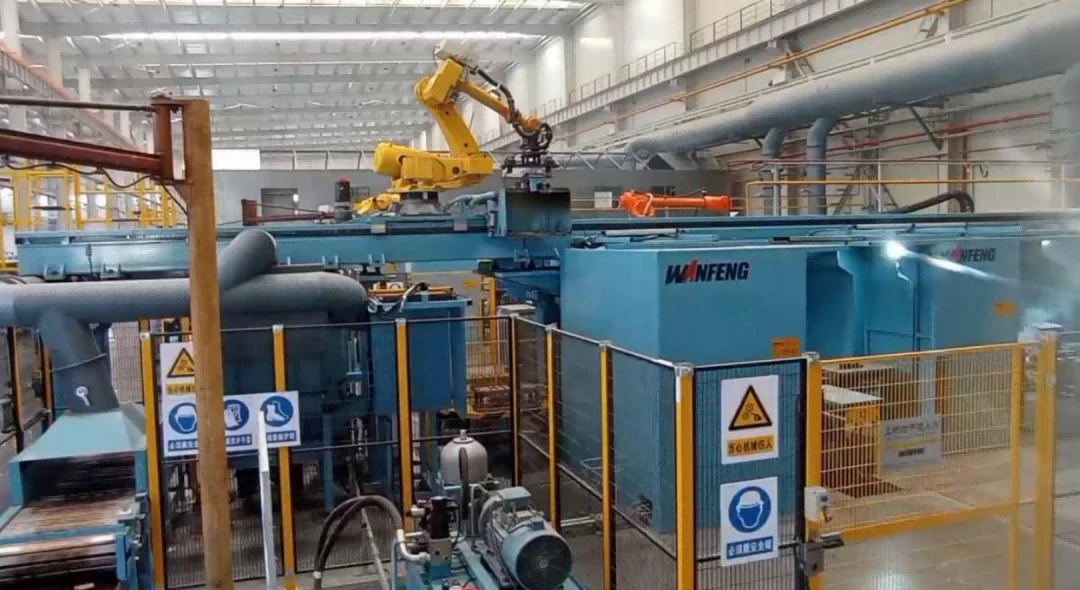
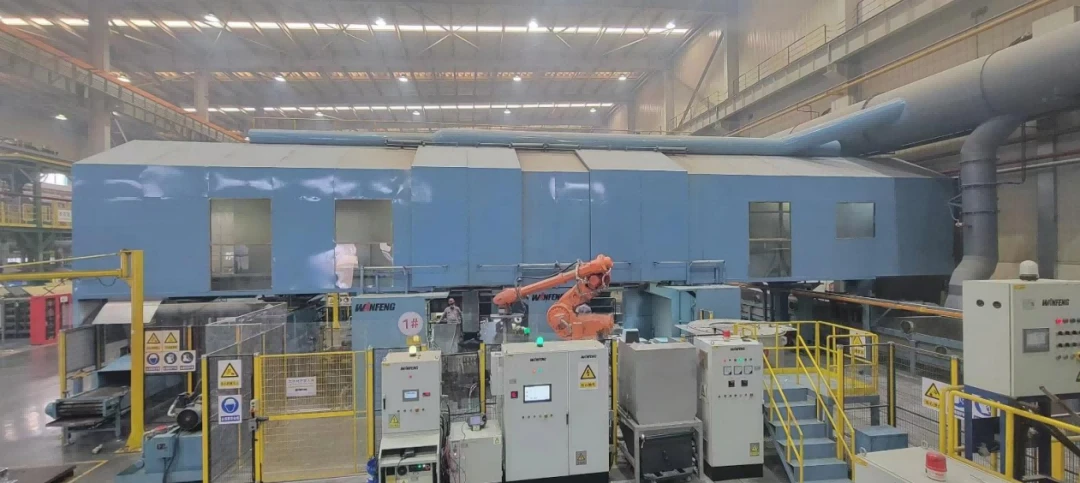
This integrated equipment package covers an automatic aluminum supply system, crucible holding furnace, degassing equipment, pouring robots, centralized conveyor line, servo gravity pouring machine, sand core rotary table, core-setting and extraction robots, and robot sliding tracks. The entire line uses robotic automation integration to complete in one stop the full complex workflow of cylinder head gravity pouring: crucible switching, molten aluminum degassing, sand core pre-setting, servo tilting pouring, casting extraction, workpiece marking, and casting de-coring. The line achieves unmanned production throughout.
Automatic aluminum supply system: after melting, molten aluminum goes through tapping and degassing before being transferred to the holding furnace on the casting line. This system replaces traditional forklift and overhead crane transfer with unmanned molten metal conveyance. A dedicated intelligent scheduling system supplies molten metal in ordered quantities, eliminating forklift safety hazards and preventing composition degradation from repeated transfers. The system integrates automatic holding furnace switching, constant-temperature heating, and high-temperature heavy-duty transfer carts to ensure continuous and stable molten aluminum supply.
Servo tilting gravity pouring machine for cylinder heads: the machine uses a servo motor driving a gear mechanism to perform tilting pouring. The pouring forward angle can be infinitely adjusted within the design range, and the return tilt supports independently variable speeds per segment with smooth transitions between action stages. High-precision servo drive ensures smooth tilting, shock-free pouring, and no gas entrainment, effectively improving internal casting quality.
Auxiliary mechanisms for the gravity pouring machine: the side mold can flip upward by 45 degrees for easy interior cleaning and coating spray. A centralized smoke extraction system collects and treats high-temperature exhaust fumes from sand cores to meet environmental emission requirements. Sand core shielding and waste collection structures gather waste sand centrally, simplifying on-site cleaning.
Intelligent cooling control system for pouring: using digital closed-loop control with excellent regulation precision, it monitors cooling medium flow and temperature in real time and dynamically adapts cooling conditions based on preset process parameters, precisely matching servo tilting pouring standards and meeting the demanding process requirements of complex cylinder head castings.
Robotic automatic pouring cell: an industrial robot equipped with a dedicated ladle autonomously completes molten metal scooping, surface slag skimming, and contour-following pouring. Molten metal pickup weight precision is controlled at ±1%, and pouring motion synchronously follows the tilting posture of the gravity machine, greatly improving pouring stability.
Robotic automatic core-setting and casting extraction cell: integrates sand core pre-setting and formed casting extraction in one workflow, with optimized gripping and placement logic specifically addressing surface scuffing defects during sand core placement.
Casting sand core cleaning device: equipped with a dedicated decoring actuator that automatically clears residual sand cores from casting exteriors, reducing sand interference in downstream machining and improving downstream process stability.
Line-wide intelligent monitoring and control system: each station across the process includes fault prediction mechanisms, with early warning for abnormal operation and audible-visual alarms for out-of-threshold parameters. A quick-changeover debug program provides an intuitive interface for efficient product changeover and commissioning.
Casting-specific MES management system: beyond standard production management functions, it adds core quality modules: full-process process data traceability, line takt monitoring and analysis, and abnormal takt alerts. It supports one-click recall of historical process parameters for individual machines, helping technicians trace the root causes of casting defects and optimize production processes.
Innovation advantages
1. After deployment, the project helps customers reduce overall energy consumption by 30%, increase overall capacity by 20%, streamline 2 operating positions, and reduce 4 workers per shift. The system integrates digital functions including equipment condition monitoring, real-time capacity tracking, OEE analysis, refined energy control, intelligent equipment inspection, on-site video surveillance, and personnel permission management. The line can seamlessly connect to the customer's existing smart foundry factory system. This project builds an integrated automated production benchmark for customers, revolutionizing the fragmented and dispersed production model and significantly improving return on investment. It also drives intelligent transformation in the aluminum alloy casting industry, providing a demonstration for high-quality development.
2. The project abandons the traditional fixed-point rotary pouring robot approach and innovatively adopts a rail-sliding pouring architecture, connecting the full automated chain: automatic molten aluminum transfer, in-line refining, automatic core setting, servo pouring, casting extraction, product marking, and cooling conveyor. This greatly reduces on-site labor, lowers worker intensity and technical barriers, and comprehensively improves the workshop environment.
3. The line is equipped with a servo hydraulic station with outstanding energy-saving benefits: the machine stops instantly when no pressure or flow is needed, avoiding long idling runs. Pressure and flow are visually adjustable via touchscreen with simple operation. The wide adjustment range allows the motor to run at low speed for extended periods, significantly cutting energy consumption at the power source. Compared with traditional pouring layouts, the rail-based line has an orderly arrangement and significantly improved plant space utilization. This project has important practical value for the gravity casting industry in achieving fully automated production, energy savings and carbon reduction, pollutant emission reduction, reduced front-line labor intensity, and improved workshop working conditions.
4. The project includes a casting-industry-customized MES management system, providing enterprises with casting defect traceability analysis, full-process quality traceability, and digital on-site production control, comprehensively elevating refined factory management.
5. This integrated equipment is the company's independently developed achievement, with multiple core technologies and corresponding proprietary intellectual property rights. The results drive technological iteration in China's automated integrated equipment industry, strengthen the company's independent innovation capability and market competitiveness, and create an industry application demonstration. It also has far-reaching strategic significance for optimizing the industrial structure of equipment manufacturing and casting processing, cultivating domestic independent brands, demonstrating "Made in China" advantages, and enhancing the international market competitiveness of Chinese casting products.